There’s a version of your face that’s five to ten years fresher than what you see in the mirror right now — and it doesn’t require a single device, a single laser, or a single day of hiding at home.
A liquid facelift uses only injectables — strategic filler placement, Botox or Dysport, and optionally Sculptra — to lift, contour, and restore your face in a single appointment. No machines. No recovery period. You walk in, you walk out, and the only evidence is that you look like you just came back from the best vacation of your life.
But here’s the part that matters: a liquid facelift isn’t “getting fillers.” It’s not filling a line here and smoothing a wrinkle there. It’s your provider looking at your entire face as an architectural system — understanding where volume has depleted, where muscles are pulling features downward, and where strategic placement can create genuine lift without touching a scalpel.
That distinction is the difference between looking filled and looking like yourself again.
Schedule a Consultation — your provider will assess your face and show you what’s possible.
How a Liquid Facelift Actually Creates Lift
Most people think filler just fills — like spackling a hole in a wall. That’s spot treatment. A liquid facelift works on a completely different principle.
Volume restoration creates mechanical lift. Here’s what’s actually happening as your face ages: the fat pads in your cheeks, temples, and under-eyes are deflating. Bone is slowly resorbing. The scaffolding that held everything up is collapsing. And when the structure underneath disappears, the skin above it descends. Those nasolabial folds you noticed last year? They’re not wrinkles. They’re skin that lost its foundation and fell.
When your provider restores volume to the cheekbone — not the fold itself — the entire mid-face lifts. The nasolabial fold softens without being directly injected. The under-eye area brightens. The skin sits the way it used to because the architecture underneath is supporting it again.
Neurotoxin releases the muscles pulling you down. Your face has muscles that lift and muscles that pull downward. As volume depletes and skin loosens, the depressor muscles start winning — pulling your mouth corners down, creating neck bands, dragging your brow. Strategic Botox or Dysport relaxes those depressors, allowing your natural elevator muscles to do their job unopposed. Your brow lifts. Your jawline sharpens. Your mouth corners come up.
Volume pushes up from below. Neurotoxin stops pulling from above. The combination creates a lift that neither achieves alone.
The Strategic Approach: Your Face, Area by Area
This is where a liquid facelift separates from spot treatment. Your provider doesn’t look at individual wrinkles — they assess your face as interconnected zones, and every injection supports a unified vision.
Cheeks — The Foundation of the Lift
This is where most of the heavy lifting happens — literally. Restoring projection to the upper cheekbone lifts the entire mid-face, softens nasolabial folds, and restores the youthful convexity that makes faces read as healthy and rested. One to two syringes placed deep on the bone can transform the relationship between every feature below it.
Temples — Opening the Eye Area
Temple hollowing is one of the earliest and most overlooked signs of aging. When the temples deflate, the eye area narrows and the upper face looks gaunt. Filling the temples opens the eye, lifts the lateral brow, and creates the visual width that frames your eyes the way they used to be framed.
Jawline — Definition and Structure
A softening jawline isn’t always about sagging skin — it’s often about the bone and tissue underneath losing definition. Strategic filler along the jawline border recreates the crisp transition between face and neck that time has blurred. Combined with neurotoxin in the platysma (the neck muscle that pulls the jaw down), the result is a cleaner, more defined lower face.
Chin — Profile and Balance
Chin projection affects how your entire profile reads. A slightly recessed chin makes the neck look shorter, the jawline less defined, and the nose more prominent by comparison. A small amount of filler at the chin can rebalance the profile in a way that improves everything around it.
Under-Eyes — Erasing Fatigue
The hollow beneath your lower lash line is often the feature that makes you look tired even when you’re not. Precise placement of a soft filler blends the transition between the lower eyelid and the cheek, eliminating the shadow that screams exhaustion.
Brow and Forehead — The Nefertiti Principle
Named after the famously sculpted Egyptian queen, the Nefertiti lift uses Botox strategically in the lower face and upper neck to create an overall lifting effect. By relaxing the depressor muscles while preserving the elevators, your provider can raise the brow position, smooth forehead lines, and sharpen the jawline — all without filler.
→ For detailed information on individual treatment areas, visit our facial balancing and dermal fillers pages.
What to Expect
Your consultation starts with your provider assessing your face — bone structure, tissue quality, fat pad position, muscle dynamics, and how your features interact. This isn’t a “what bothers you?” conversation. It’s a comprehensive evaluation of your facial architecture.
The treatment takes 45 to 90 minutes. Topical numbing is applied for comfort. Your provider places three to six syringes of filler (typical range for a full liquid facelift) across multiple zones, plus strategic Botox or Dysport. Every injection is purposeful — there’s nothing random about it.
Immediately after: You’ll see improvement right away. Some swelling is normal and will settle over 48 to 72 hours. Mild bruising is possible but manageable with concealer. Most patients return to normal activities the same day.
Results timeline:
- Day 1–3: Visible improvement through mild swelling. Don’t judge yet.
- Week 2: Swelling resolved. Filler settled. This is your real result.
- Week 3–4: Botox/Dysport at full effect. The lifting from neurotoxin now combines with the volume from fillers.
- If Sculptra included: Gradual collagen building over 4 to 12 weeks. Your results keep improving for months.
How long it lasts: Hyaluronic acid fillers last 9 to 18 months depending on the product and placement area. Botox/Dysport lasts 3 to 4 months. Sculptra lasts 2+ years. Maintenance visits keep your results fresh without repeating the full treatment.
Liquid Facelift Before & After
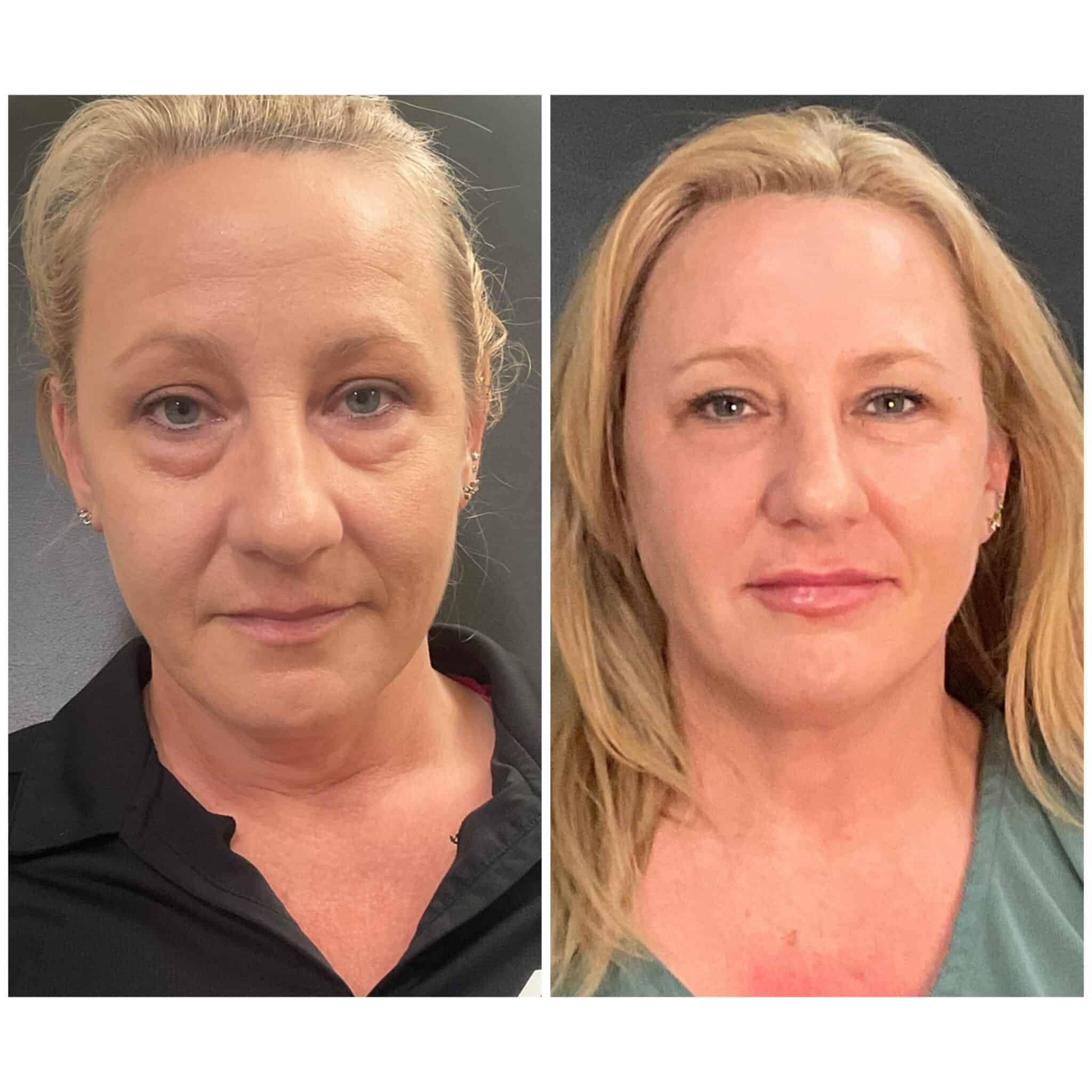
This result shows the strategic liquid facelift approach — multiple products placed across multiple zones to create unified facial rejuvenation. Not a single-area treatment. Unretouched.
Your provider will show you before-and-after examples of patients with similar concerns during your consultation.
Liquid Facelift Cost in Ashland, OR
A liquid facelift is a premium injectable treatment — and the investment reflects the strategic expertise required to treat the entire face as a system rather than filling individual lines.
For context: a surgical facelift averages $9,536 according to the American Society of Plastic Surgeons — before anesthesia, facility fees, and follow-up care push the total to $12,000 to $30,000+. Recovery takes weeks. Risks include general anesthesia complications, nerve damage, scarring, and the unpredictability of any surgical procedure.
A liquid facelift delivers meaningful, visible rejuvenation — volume restored, features lifted, contour redefined — in a single appointment with zero surgical risk and zero downtime. The results aren’t permanent (fillers last 9 to 18 months, neurotoxin 3 to 4 months), but the reversibility is actually an advantage: your face changes over time, and your treatment evolves with it rather than locking you into a surgical result.
Your specific investment depends on the number of syringes, the products selected, and whether Sculptra is included in your plan. Your provider will give you exact pricing during your consultation — no surprises.
For ongoing maintenance, the IllumèNaughty Beauty Bank membership makes your care sustainable. Your monthly investment banks and rolls over, and members receive 14% off Botox and Dysport and 7% off fillers and all other services.
Schedule a Consultation — your provider will assess your face and walk you through pricing specific to your goals.
A Liquid Facelift Is Not “Getting Fillers”
This is worth saying directly, because it’s the most common misconception about what we do.
“Getting fillers” is reactive. You notice a line, you fill the line. You see a shadow, you inject the shadow. Each visit addresses whatever bothers you most that day. The results are disconnected — a little volume here, a little smoothing there — and over time, the face can start to look unbalanced because no one ever stepped back and looked at the whole picture.
A liquid facelift is strategic. Your provider starts by assessing the underlying cause of what you see in the mirror — and most of the time, the cause isn’t where the symptom is. That nasolabial fold? It’s a cheek volume problem. That tired under-eye? It’s a midface descent issue. That soft jawline? It’s a chin projection deficit combined with a depressor muscle that’s winning.
When you treat the cause instead of the symptom, everything above it improves. The fold softens without being directly filled. The eye brightens because the cheek is supporting it. The jaw sharpens because the chin now anchors it. The results look natural because they ARE natural — they’re your own facial architecture, rebuilt.
That’s why facial balancing expertise matters. A practice that understands how every zone of your face interacts with every other zone produces results that a line-by-line approach never will.
When You Need More Than a Liquid Facelift
We’d rather be honest with you now than have you disappointed later.
A liquid facelift is ideal for patients with early to moderate volume loss, mild laxity, and skin that still has reasonable quality. It restores, lifts, and contours beautifully — within the limits of what injectables alone can achieve.
A liquid facelift cannot:
- Tighten loose, crepey skin (that’s a texture and elasticity issue, not a volume issue)
- Lift severe jowling that’s descended below the jawline
- Address deep neck bands or significant neck laxity
- Resurface sun-damaged skin or smooth acne scars
If your concerns go deeper than volume and muscle dynamics, we offer a non-surgical facelift — a two-session combination of Profound RF, CO2 laser resurfacing, and facial balancing that addresses laxity, skin quality, AND volume together. It’s more intensive, with real recovery time, but it produces results that injectables alone can’t match.
And if your concerns are structural — significant tissue descent, deep jowling, substantial neck laxity — a surgical facelift may genuinely be the better path. We’ll tell you that directly, because recommending the right treatment is always more valuable than selling the one in front of us.
Your provider will assess where you fall on this spectrum and recommend accordingly.
Frequently Asked Questions
How much does a liquid facelift cost?
The investment depends on how many syringes your face needs (typically three to six for a full liquid facelift), which products are selected, and whether Sculptra is included. It’s a fraction of a surgical facelift ($12,000–$30,000+) and involves zero downtime. Your provider will give you specific pricing during your consultation. The IllumèNaughty Beauty Bank membership makes ongoing maintenance more affordable with 14% off neurotoxins and 7% off fillers.
Are liquid facelifts worth it?
For the right candidate — someone with early to moderate volume loss who wants visible rejuvenation without devices or surgery — a liquid facelift consistently delivers high satisfaction. The key is the strategic approach: treating the face as a system rather than filling individual lines. When done well, the result looks like you turned back the clock five to ten years without anyone being able to pinpoint what changed. If your concerns include significant skin laxity or severe sagging, a non-surgical facelift or surgical consultation may serve you better.
How long do liquid facelifts last?
Different components have different durations. Hyaluronic acid fillers (Juvéderm, Restylane) last 9 to 18 months depending on the product and area. Botox and Dysport last 3 to 4 months. Sculptra, if included, lasts 2+ years. Most patients return for a neurotoxin touch-up every three to four months and a partial filler refresh every nine to twelve months — maintaining their results without ever repeating the full treatment.
What is the difference between a facelift and a liquid facelift?
A surgical facelift physically repositions and tightens tissue through incisions under general anesthesia, removes excess skin, and produces results lasting 7 to 10 years. Recovery takes weeks. A liquid facelift uses only injectables to restore volume and rebalance muscles — no incisions, no anesthesia, no downtime. Results last 9 to 18 months. The liquid facelift is ideal for early to moderate aging; surgery is better for significant structural descent.
How many syringes do I need for a liquid facelift?
A typical full liquid facelift uses three to six syringes of filler distributed across multiple areas (cheeks, temples, jawline, chin, and sometimes under-eyes and lips), plus 20 to 40 units of Botox or Dysport placed strategically. Your provider determines the exact number based on your anatomy, your degree of volume loss, and your goals. Some patients achieve their goals with fewer; others benefit from a Sculptra foundation plus fillers for a more comprehensive approach.
Does a liquid facelift hurt?
Most patients describe it as very tolerable. All Juvéderm and Restylane products contain built-in lidocaine, so each injection gets more comfortable as the treatment progresses. Topical numbing cream is applied beforehand for sensitive areas. The Botox and Dysport injections feel like brief pinches. Most patients say it’s far easier than they expected.
What is the difference between a liquid facelift and a non-surgical facelift?
A liquid facelift uses injectables only — fillers, Botox/Dysport, and optionally Sculptra. No devices, no lasers, minimal downtime. A non-surgical facelift at Illume combines Profound RF microneedling + CO2 laser resurfacing + facial balancing in a two-session protocol that addresses skin laxity and skin quality in addition to volume. The liquid facelift is the lighter approach for patients with primarily volume-driven aging. The non-surgical facelift is the more comprehensive protocol for patients who also need skin tightening and resurfacing.
Schedule Your Liquid Facelift Consultation
If you’ve been looking in the mirror and thinking “I don’t look tired — I AM tired of looking like this” — this might be the conversation that changes your relationship with your reflection.
Your provider will assess your facial architecture, explain where volume has shifted and where muscles are creating drag, and show you what’s possible with a strategic injectable approach. No pressure. No commitment until you’re ready. Just an honest assessment from someone who treats faces every day and knows what works.
Call us: (541) 631-8387
Visit us: 993 Siskiyou Blvd Suite 1, Ashland, OR 97520