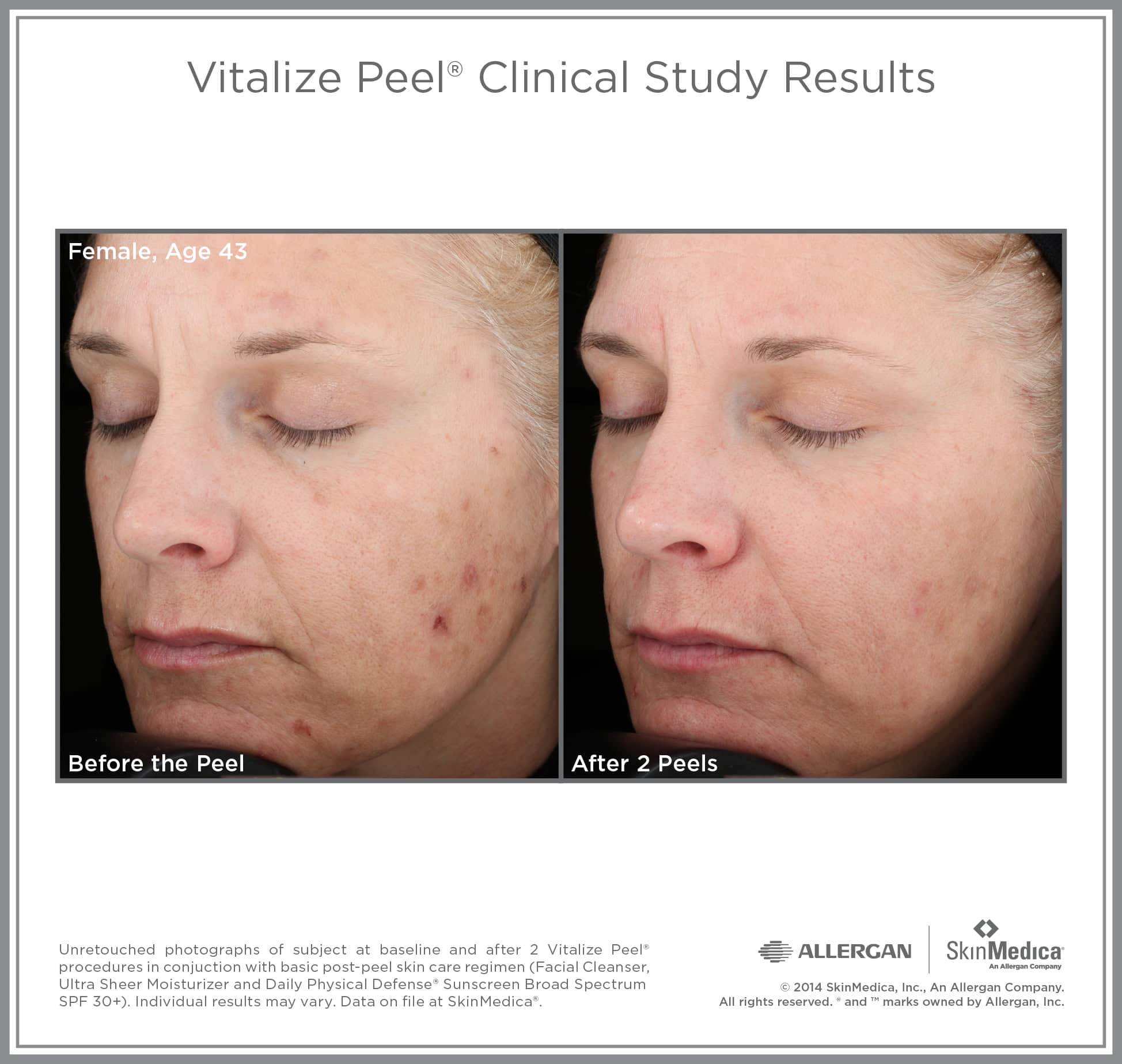
VI Peel, SkinMedica, PCA Skin, and Lira Clinical
Here’s what your skincare routine can’t do: it can’t get past its own barrier. No matter how good your serums are, no matter how religiously you apply them, they’re working on skin that’s covered in a layer of dead cells, sun damage, and accumulated texture that limits everything underneath.
A chemical peel removes that barrier. Professionally. Precisely. And with the kind of controlled chemistry that reveals skin you forgot was in there.
At Illume, we carry four professional peel lines — VI Peel, SkinMedica, PCA Skin, and Lira Clinical — because your skin isn’t a one-peel-fits-all situation. We offer light peels you can get on a lunch break, medium peels that address real damage, and deep peels that produce the kind of transformation you can see across a room. Your provider selects the acid, the depth, and the formulation based on what your skin actually needs — not what happens to be in stock.
The result? Skin that’s clearer, smoother, more even, and fundamentally healthier than anything a product alone can produce.
How Chemical Peels Work
The science is elegant even if the word “peel” makes it sound dramatic: a professional-strength acid solution is applied to your skin, where it breaks the bonds holding dead and damaged cells to the surface. Those cells lift and shed over the following days. What’s left is the healthier, more vibrant skin your body has been building underneath — skin that’s been waiting for the old layer to get out of the way.
But peeling is only half the story. The controlled exfoliation also triggers your skin’s wound-healing response — accelerated cell turnover, increased collagen production, and improved melanin regulation. The surface renewal you see in the mirror is the old skin leaving. The improvement you notice weeks later is the new skin arriving — with better structure, better pigment distribution, and better texture than what it replaced.
Different acids work at different depths, target different concerns, and produce different levels of results and recovery. That’s why having four peel lines — and a provider who knows which acid to select for your skin type — matters more than any single product name.
Light, Medium, and Deep — Choosing Your Depth
Light (Superficial) Peels
Light peels work on the outermost skin layer. They use lower concentrations of glycolic, lactic, mandelic, or salicylic acid to gently brighten tone, smooth texture, and improve clarity with minimal disruption to your day.
What they address: Dullness, mild uneven tone, superficial texture, enlarged pores, light sun damage, mild acne Recovery: Minimal — one to three days of mild tightness or light flaking. Many patients wear makeup the next day. Frequency: Every two to four weeks for a series, then monthly maintenance Best for: Patients new to peels, sensitive skin types, maintenance between deeper treatments, a pre-event “glow-up”
Light peels are also available as an upgrade to your Illuminate Facial — your aesthetician can layer one into the facial protocol for enhanced exfoliation and product penetration.
Medium Peels
This is where the real work happens. Medium peels penetrate into the upper dermis — the layer below the surface where collagen lives and where most visible damage resides. TCA, Jessner’s solution, and the VI Peel fall here.
What they address: Acne scars, moderate hyperpigmentation, melasma, sun damage, fine lines, uneven texture that light peels haven’t resolved Recovery: Five to seven days of visible peeling. Your skin will look worse before it looks better — the peeling IS the treatment working. Frequency: Every two to three months, or as a targeted series Best for: Patients with specific concerns who want visible improvement and can manage a week of peeling
Deep Peels
Deep peels penetrate into the mid-dermis for the most significant results of any chemical peel. Higher concentrations of TCA or phenol-based formulations produce dramatic improvement — with recovery to match.
What they address: Deep wrinkles, severe sun damage, significant scarring, advanced texture irregularities Recovery: Two or more weeks of significant peeling, redness, and sensitivity Frequency: Typically once, or very infrequently Best for: Patients who have exhausted lighter options and are committed to the recovery for maximum results
Our Peel Lines — Four Options, Every Skin
VI Peel
The most popular branded peel in the med spa market — and for good reason. VI Peel uses a proprietary blend of TCA, retinol, salicylic acid, phenol, and vitamin C to address multiple concerns simultaneously. It’s a medium-depth peel that’s remarkably well-tolerated for its level of results.
We carry all four VI Peel formulations:
- VI Peel Original — the all-around skin rejuvenation peel for tone, texture, and early aging
- VI Peel Precision Plus — specifically formulated for melasma and stubborn hyperpigmentation, with additional boosters targeting melanin production
- VI Peel Purify — designed for acne-prone and oily skin, addressing active breakouts and congestion
- VI Peel Advanced — the strongest formulation for aggressive aging, sun damage, and deep texture
The VI Peel is self-neutralizing — it stops working on its own — which contributes to its predictable results. You remove it at home after several hours, per specific instructions your provider gives you.
SkinMedica Peels — By the Makers of Botox

From the same Allergan Aesthetics family behind Botox, Juvéderm, and DiamondGlow. SkinMedica has been revolutionizing professional skincare since 1999 — backed by 100+ peer-reviewed publications and 200+ clinical efficacy studies. Three professional peel depths:
Illuminize Peel — The lightest SkinMedica option. Antioxidants and natural extracts gently exfoliate for vibrant, radiant-looking results with minimal downtime and no visible peeling. The perfect first peel. Pairs beautifully with dermaplaning and DiamondGlow in the same visit — the brochure shows a patient who received all three in a single appointment with visible improvement by week one.
Vitalize Peel — The workhorse. Smooths away mild to moderate fine lines, wrinkles, acne scarring, and skin tone unevenness. Noticeable results after just one peel, with compelling results after three to six. Minimal downtime — a few days of light peeling. This is the peel most of our patients come back for repeatedly.
Rejuvenize Peel — The most potent SkinMedica formula. Dramatically smooths fine lines, wrinkles, and skin tone unevenness from acne scarring. Noticeable results after one peel, compelling after three to six. More downtime — but the results reflect the intensity.
PCA Skin Peels
One of the most extensive professional peel portfolios in the industry — over a dozen formulations targeting specific concerns and skin types. PCA peels are particularly well-regarded for their customizability and their proven safety across diverse skin tones. When your provider needs a formulation that’s precisely matched to a specific concern and a specific Fitzpatrick type, PCA often has the exact answer.
Lira Clinical Peels
Lira brings a science-forward approach with peels that incorporate plant stem cells, peptides, and bio-available nutrients alongside traditional acid formulations. Particularly effective for patients who want the benefits of chemical exfoliation combined with active calming and nourishing ingredients — ideal for sensitive or reactive skin that other peels irritate.
Four lines means your provider isn’t locked into one brand’s limitations. The peel matches your skin — not the other way around.
What Chemical Peels Treat
Acne and Acne Scars
Peels containing salicylic acid penetrate into pores to clear congestion from within — one of the most effective approaches for active acne. For scarring, medium-depth peels stimulate collagen remodeling in damaged tissue, smoothing and improving texture over a series. For deeper scars, peels combine beautifully with microneedling or laser resurfacing.
Hyperpigmentation and Sun Damage
Dark spots, age spots, and the uneven discoloration from years of UV exposure. Chemical peels accelerate turnover of pigmented cells while inhibiting new melanin production deeper in the skin. The VI Peel Precision Plus and SkinMedica’s Even & Correct Advanced Brightening formulations are specifically designed for stubborn pigmentation — and the SkinMedica clinical data shows patients saw visibly brighter, more even skin in as little as one week.
Melasma
The most notoriously stubborn pigmentation condition — and the one that requires the most careful acid selection. Aggressive peels can actually worsen melasma by triggering rebound hyperpigmentation. The VI Peel Precision Plus was designed specifically for melasma. Our PCA and Lira lines include melasma-safe formulations. And SkinMedica’s Even & Correct Advanced Brightening Treatment — the product that complements the Vitalize Peel for pigmentation — is retinol-free, hydroquinone-free, and tested across all skin types and multiple ethnicities with 93% patient satisfaction. Your provider will assess your melasma type and select the peel that treats without triggering.
Fine Lines and Texture
Medium and deep peels stimulate collagen in the dermis — the structural layer where lines form. New collagen fills fine lines from within while improved cell turnover resurfaces texture. Peels won’t replace what Botox or fillers do for deeper wrinkles — but for surface lines and crepey texture, they’re remarkably effective. The SkinMedica Rejuvenize Peel clinical data shows noticeable results after just one treatment.
Dullness and Rough Texture
Even without a specific “problem,” chemical peels produce the kind of clarity and smoothness that makes people ask what you changed. Light peels in particular are the maintenance treatment that keeps skin looking fresh, reflective, and healthy between more intensive services.
Chemical Peels Before and After
Results from chemical peel treatments using our professional peel lines — showing improvements in acne scarring, hyperpigmentation, melasma, fine lines, texture, and overall skin clarity.
Results vary based on peel type, depth, number of sessions, and individual skin characteristics. The peeling phase looks worse than the final result — what’s underneath is worth the wait. Your provider will set realistic expectations during your consultation.
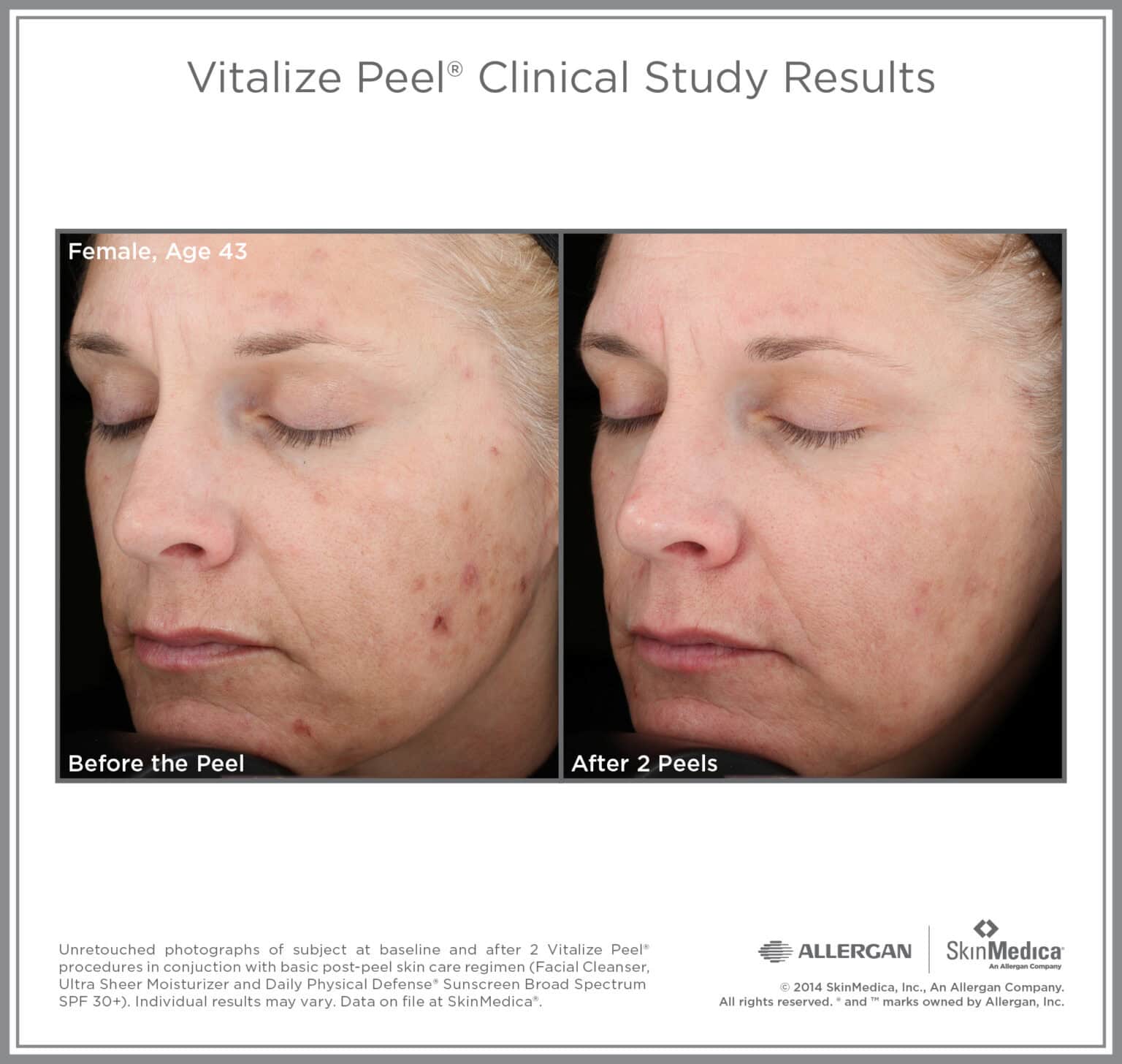
Improvement in tone, texture, and fine lines.
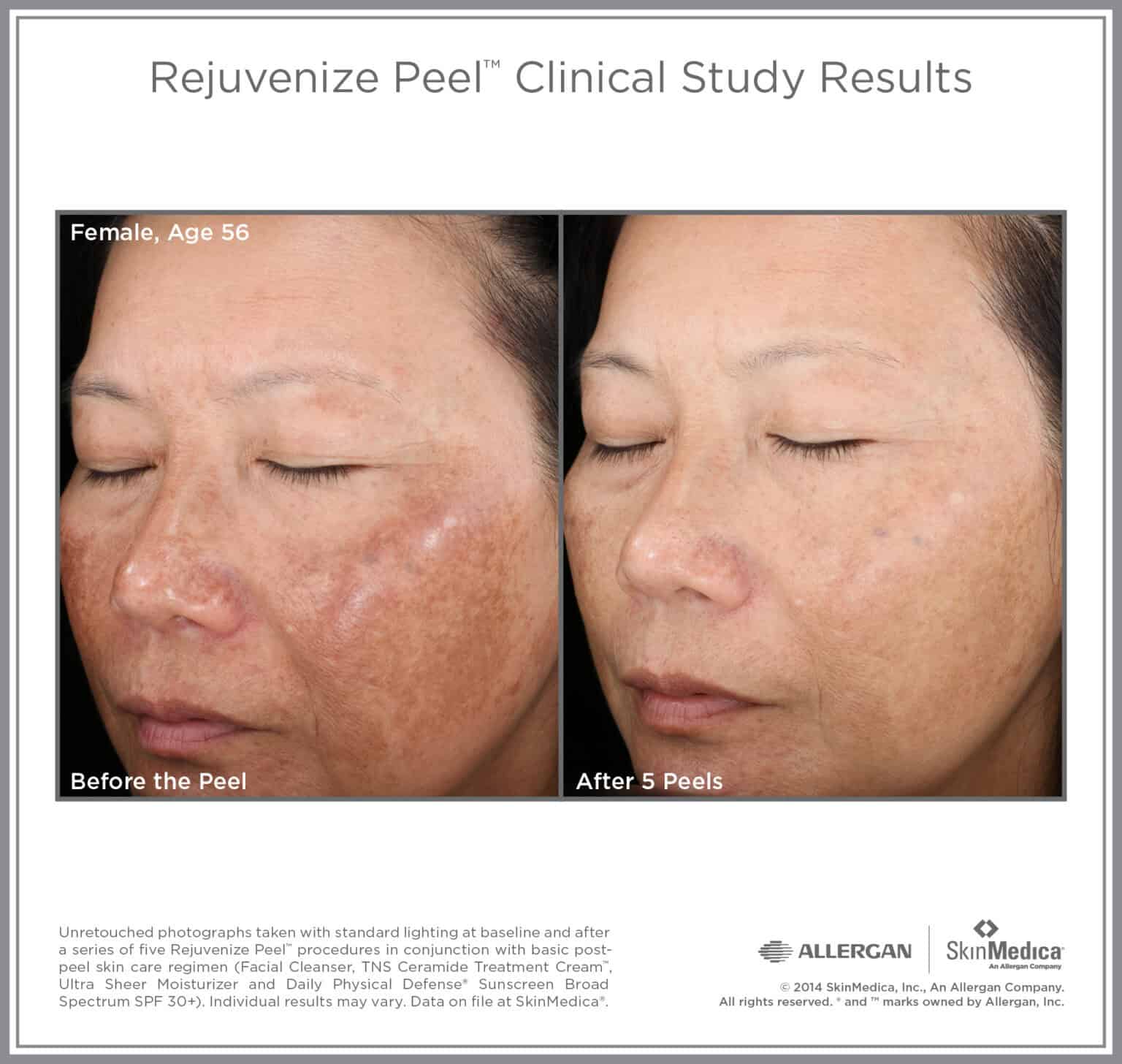
Noticeable softening of wrinkles and sun damage.
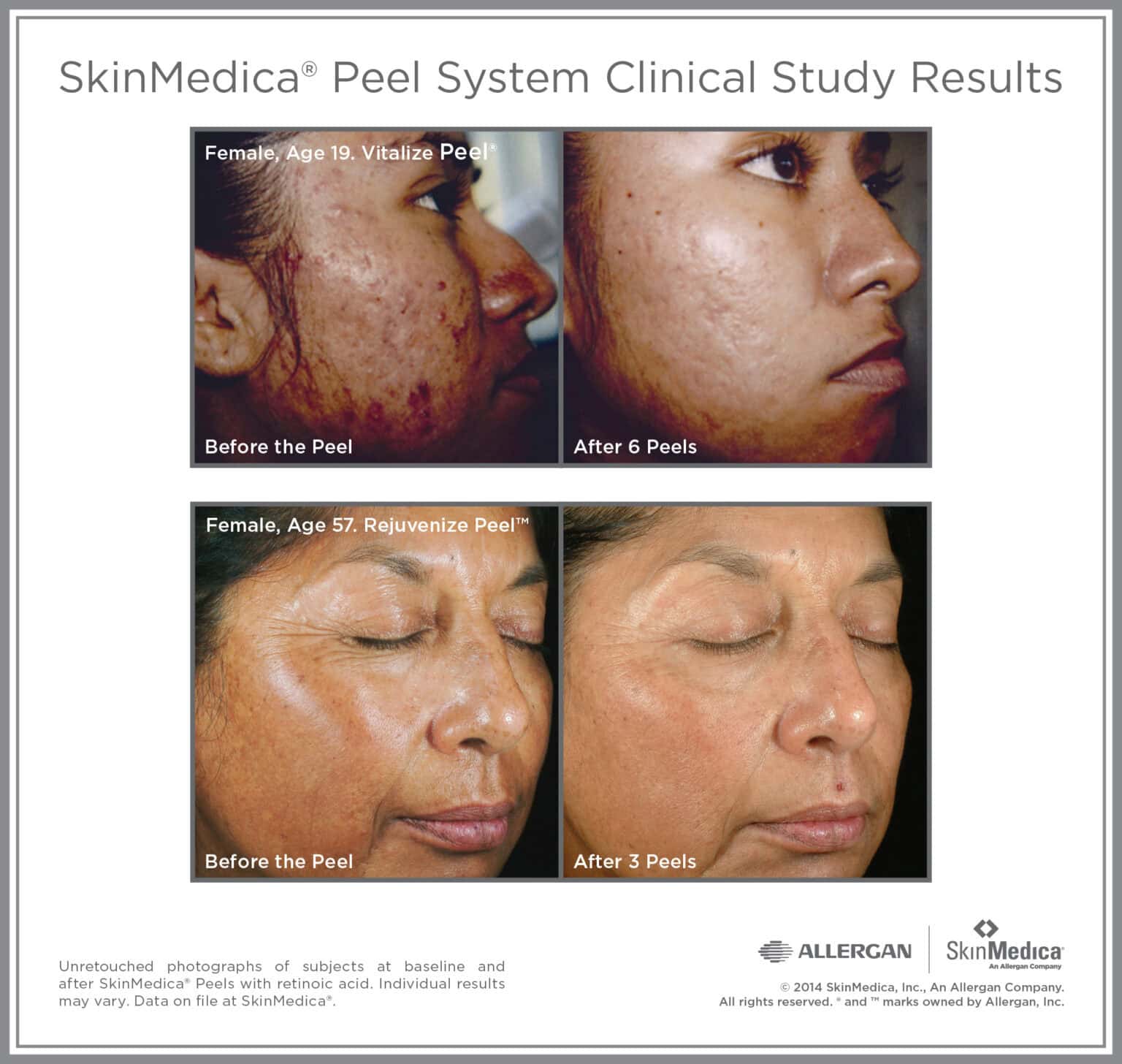
A broader age range showing acne and aging improvement.
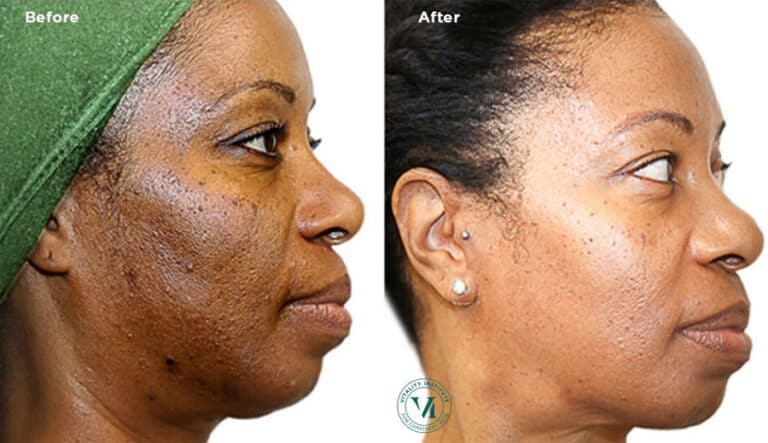
Focused pigment correction in a lower-resolution clinical before and after.
What Your Treatment Looks Like
The consultation. Your provider assesses your skin type, current concerns, skincare routine, medication history, and goals. Acid selection, depth, and product line are determined here — before anything touches your face.
Prep (if needed). For medium and deep peels, you may prep your skin for one to two weeks with specific products — retinoids, hydroquinone, or gentle acids — to prime for more even penetration. Light peels often need no prep.
The peel. Your provider cleanses your face and applies the acid solution in controlled layers. You’ll feel tingling, warmth, and possibly stinging — intensity depends on depth. Light peels are mild. Medium peels are more intense but brief. Application takes 15 to 30 minutes.
After application. Some peels are neutralized during your appointment. Others — like the VI Peel — are self-neutralizing and removed at home hours later per specific instructions. Your provider gives you a detailed aftercare kit and timeline.
Recovery by Depth
| Depth | What you’ll see | Social downtime | Peak peeling | Back to normal |
|---|---|---|---|---|
| Light | Mild tightness, slight flaking | None to 1 day | Days 2-3 | 3-4 days |
| Medium | Visible peeling, redness, tightness | 5-7 days | Days 3-5 | ~1 week |
| Deep | Significant peeling, redness, sensitivity | 2+ weeks | Days 5-10 | 2-3 weeks |
The peeling phase. Your skin will sheet-peel, flake, or slough in patches. It’s not painful — just visually unappealing for a few days. Do not pick, pull, or scrub. Let it release naturally. What emerges underneath is why you came.
How Peels Fit with Your Other Treatments
Chemical peels are one of the most versatile treatments we offer for combining with other services.
Peels + Dermaplaning. Dermaplaning before a light peel removes the dead skin barrier and peach fuzz, allowing the acid to penetrate more evenly. One of the most popular combinations at Illume — and one the SkinMedica clinical data highlights: a patient who received dermaplaning, DiamondGlow with Even & Correct Advanced Brightening Pro-Infusion Serum, and an Illuminize Peel in a single visit showed visible improvement by week one.
Peels as an Illuminate Facial upgrade. Your aesthetician can layer a light peel into your custom facial protocol for deeper exfoliation beyond what topical products alone provide.
Peels + DiamondGlow. The SkinMedica brochure shows DiamondGlow paired with Vitalize Peel and Even & Correct Advanced Brightening Pro-Infusion Serum — a combination that produced visible improvement in a Fitzpatrick V patient at week four and continued improving at week eight. The treatment-to-take-home bridge means your in-office peel results are extended by the medical-grade SkinMedica products you use at home.
Peels + Microneedling. Different mechanisms, complementary results. Peels work from the surface down; microneedling works from the inside up. Scheduled in alternating sessions, they accelerate improvement in texture, scarring, and pigmentation.
Peels + IPL Photofacial. IPL targets pigment and vascular concerns with light; peels address surface texture and tone with acid. Together — the most comprehensive correction for sun-damaged skin.
Who Should — and Shouldn’t — Get a Chemical Peel
Good candidates:
- Most skin types with appropriate acid selection
- Patients with acne, scarring, pigmentation, texture concerns, or general dullness
- Committed to post-peel care (SPF is non-negotiable)
- Realistic about recovery timelines for deeper peels
Important for darker skin tones: Not all acids are safe for all Fitzpatrick types. Glycolic acid and TCA carry higher risk of post-inflammatory hyperpigmentation in darker skin. Mandelic acid, lactic acid, and carefully formulated peels like the VI Peel Precision Plus and SkinMedica’s Even & Correct Advanced Brightening Treatment (retinol-free, hydroquinone-free, tested across all skin types and multiple ethnicities) are safer options. Our PCA line is particularly well-regarded for diverse skin tone safety. Your provider will select the acid and depth appropriate for your skin — and if a peel isn’t the right tool, they’ll say so.
Skip the peel if you have:
- Active cold sores or herpes simplex (peels can trigger outbreaks — antiviral prophylaxis may be prescribed)
- Pregnancy or breastfeeding
- Current or recent isotretinoin (Accutane) use (wait at least six months)
- Recent significant sun exposure or active sunburn
- Open wounds or active eczema/dermatitis in the treatment area
Frequently Asked Questions
How much does a chemical peel cost?
We don’t publish specific pricing because the peel type, depth, and product line vary by patient. For context: a single professional peel costs a fraction of what laser resurfacing does — and for mild to moderate concerns, a peel series can achieve comparable improvement in texture and pigmentation. IllumèNaughty Beauty Bank members receive their discount. Your provider discusses exact pricing during your consultation.
What is a VI Peel?
The VI Peel is one of the most popular medium-depth professional peels, using a blend of TCA, retinol, salicylic acid, phenol, and vitamin C. It’s self-neutralizing — you remove it at home after several hours — and comes in four formulations: Original (rejuvenation), Precision Plus (melasma and hyperpigmentation), Purify (acne), and Advanced (aging). We carry all four at Illume.
How many chemical peel sessions do I need?
It depends on depth and concern. Light peels: four to six sessions every two to four weeks, with monthly maintenance. Medium peels: two to four sessions every two to three months — the SkinMedica data shows compelling results after three to six peels. Deep peels: typically one treatment. Your provider maps a plan based on your skin assessment.
Does a chemical peel hurt?
Light peels feel like mild tingling. Medium peels feel like stronger stinging for a few minutes. Deep peels are more intense but managed with numbing. The discomfort is brief — application takes 15 to 30 minutes — and subsides once the peel is neutralized or absorbed.
How long does the peeling last?
Light peels: one to three days of mild flaking. Medium peels: five to seven days of visible peeling — sheet-peeling peaks around days three to five. Deep peels: two or more weeks. Don’t pick or pull — let it release naturally for the best result.
Can a chemical peel help with melasma?
Yes — but acid selection is critical. Aggressive peels can worsen melasma by triggering rebound hyperpigmentation. The VI Peel Precision Plus is specifically formulated for melasma. SkinMedica’s Even & Correct Advanced Brightening Treatment — which complements the Vitalize Peel — is clinically proven to reduce the appearance of melasma, is retinol-free and hydroquinone-free, and was preferred by patients over the leading prescription melasma treatment with less irritation. Your provider selects the peel that treats without triggering a flare.
Can I get a chemical peel if I have dark skin?
Yes — with the right acid. Mandelic acid and lactic acid carry lower hyperpigmentation risk than glycolic or TCA. The VI Peel Precision Plus is designed to be safer across skin types. SkinMedica’s Even & Correct formulations are tested on all skin types and multiple ethnicities. Our PCA line has specific formulations optimized for darker Fitzpatrick types. Your provider selects the appropriate acid for your skin.
How soon can I wear makeup after a chemical peel?
Light peels: the next day. Medium peels: typically day five to seven once active peeling subsides. Deep peels: two weeks or when your provider clears you. Mineral makeup is generally safer during recovery than liquid foundation.
The Treatment That Never Goes Out of Style
Devices come and go. Trends cycle. Chemical peels have been producing real results for real skin concerns since before most of the technology in our treatment room existed — and they’re still one of the most effective tools we have.
Four peel lines. Every depth. Every concern. And a team that knows which acid your skin needs — not which one has the biggest marketing budget.