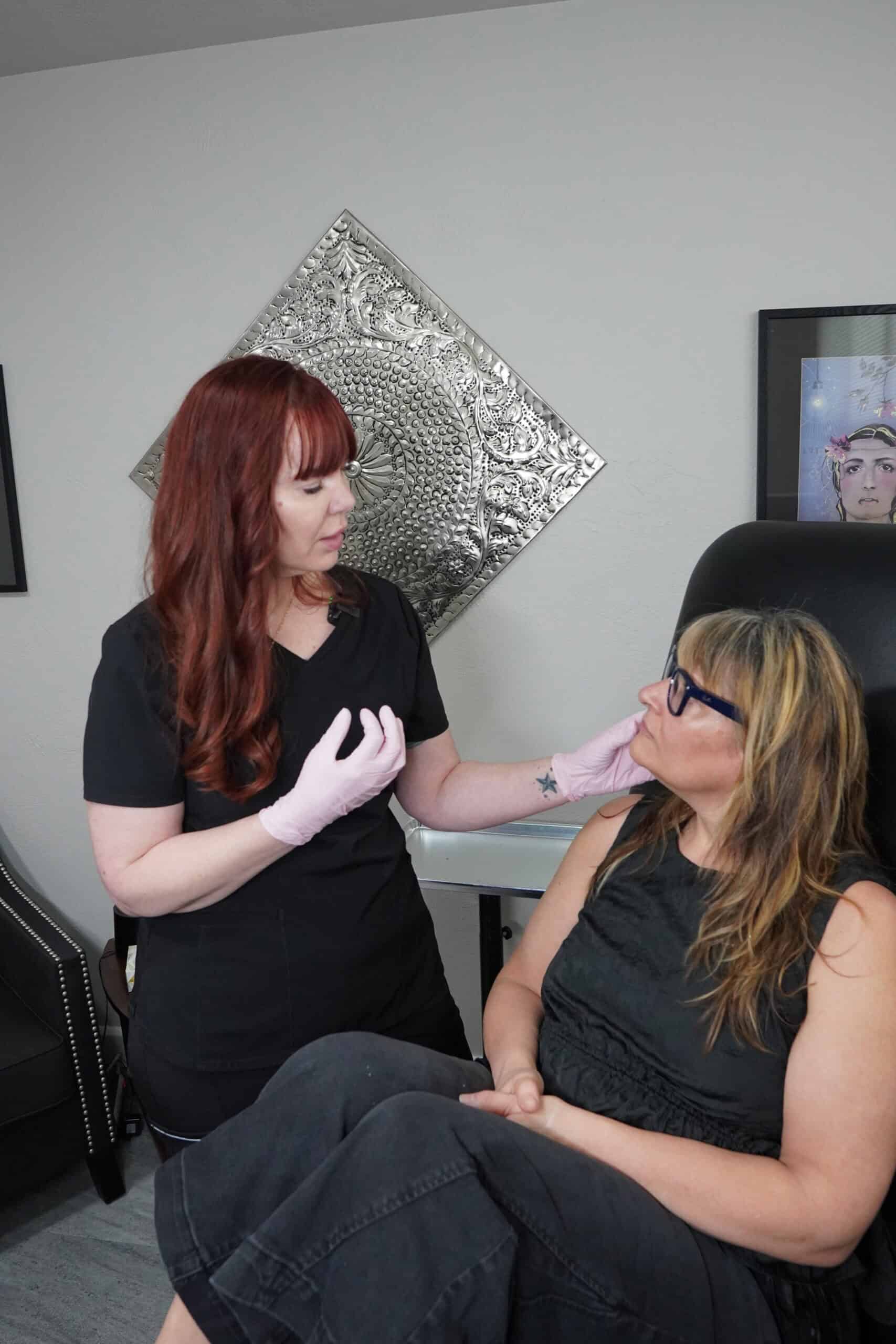
You did the hard thing. You lost the weight — maybe 30, 40, 60 pounds — and your body feels like yours again. But the face looking back at you in the mirror? It looks tired. Hollow. Older than you feel. The cheeks have flattened, the temples have sunk, and there are shadows under your eyes that no amount of sleep seems to fix.
You’re not imagining it. And you’re not vain for noticing.
Located in Ashland, OR — serving patients from Medford, Grants Pass, Central Point, Jacksonville, Phoenix, Talent, and across the Rogue Valley.
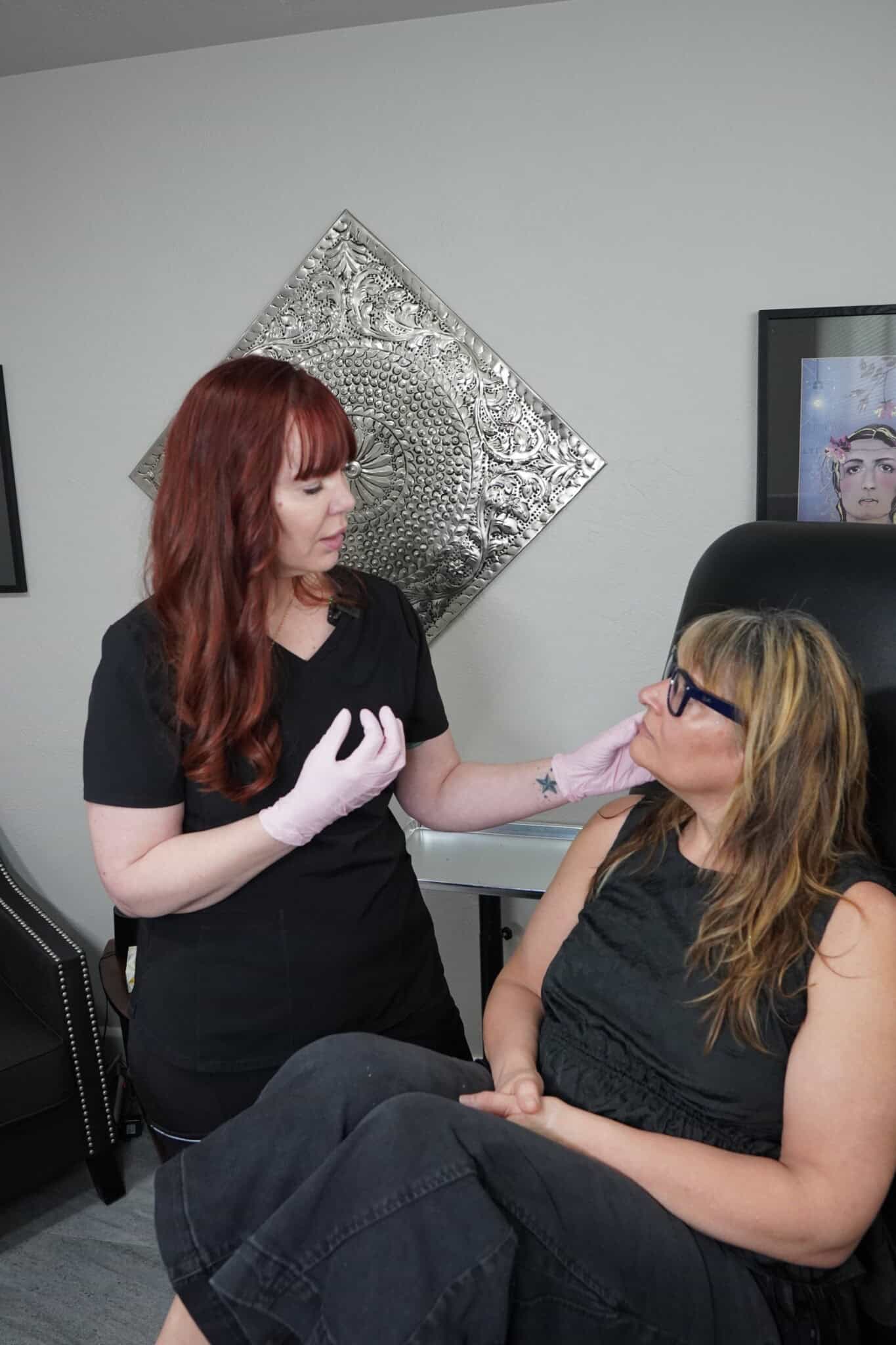
What you’re seeing has a name — “Ozempic face” — and it’s one of the most common things we talk through with patients who’ve lost significant weight on a GLP-1 medication like Ozempic, Wegovy, Mounjaro, or Zepbound. The good news: the volume you lost can be restored, gradually and naturally, so the face matches the body you worked so hard for. Not frozen. Not overfilled. Just you — rested and like yourself again.
Our team at Illume Aesthetics has spent 20+ years helping people in Southern Oregon age on their own terms — we’re in the top 5% of U.S. med spas for injectables, with more than 800 five-star reviews behind us. If your face changed faster than you expected, let’s talk about what’s actually happening — and what a thoughtful plan looks like.
What Is Ozempic Face?
“Ozempic face” is the gaunt, hollow, prematurely aged look that can follow rapid weight loss on a GLP-1 medication. It isn’t a side effect of the drug itself — it’s a side effect of losing weight quickly. When the pounds come off fast, they come off everywhere, including the small fat pads that give your face its youthful structure.
Here’s what’s happening underneath. Your face is built on layered compartments of fat that sit on top of bone and muscle. They’re what make cheeks look full, temples look smooth, and the area under your eyes look rested. When you lose weight rapidly, those pads shrink — and because the skin that was draped over them doesn’t snap back as fast as the volume disappears, you’re left with hollowing, sagging, and deeper folds. Hollow temples. Flattened cheeks. Deepened smile lines. Shadowed under-eyes. A jawline that’s softened instead of sharpened.
This is measurable, not just a feeling. A 2025 Vanderbilt imaging study (Sharma et al., Otolaryngology–Head and Neck Surgery) used before-and-after CT and MRI scans and found a median 9% loss of midface volume in GLP-1 patients — roughly 7% of facial volume for every 10 kilograms (about 22 pounds) of weight lost. And you’re far from alone: in an Allergan survey presented at the 2026 American Academy of Dermatology meeting, 61% of GLP-1 patients reported midface volume loss and 50% reported skin laxity.
So if you’ve thought “I lost the weight but I look ten years older,” that’s a real, documented, common experience — and it’s treatable. The goal isn’t to undo your progress. It’s to restore the structure the weight loss took.
How to Fix Ozempic Face: A Plan in Layers
There’s no single injection that fixes Ozempic face, and you should be skeptical of anyone who promises one. Restoring a face that’s lost volume across multiple areas takes a layered plan — and the right plan depends on how much volume you’ve lost, how fast you’re still losing, and what you want to look like. That’s exactly what a medical aesthetics consultation is for.
Here’s how our team thinks about it.
Layer 1: Sculptra — Rebuild Your Own Collagen
For diffuse, all-over volume loss — the hallmark of Ozempic face — Sculptra is usually the foundation. Sculptra isn’t a filler. It’s a biostimulator made from poly-L-lactic acid, and instead of sitting in your tissue like a gel, it prompts your body to build its own new collagen over several weeks and months.
That distinction matters for GLP-1 patients specifically. Because Sculptra rebuilds your collagen, the volume it creates is your own tissue — which looks and moves naturally, integrates seamlessly, and lasts two years or more. It’s gradual by design, so no one sees a sudden change. They just notice you look rested. Most facial plans involve two to three sessions spaced four to six weeks apart.
Layer 2: Restylane Lyft or Juvéderm Voluma — Restore Midface Volume Now
Sculptra is the long game. But it builds slowly, and most people don’t want to wait three months to see anything. That’s where dermal fillers for Ozempic face come in — a hyaluronic acid filler placed in the midface to restore cheek and structural volume immediately, giving you a visible lift on day one while the Sculptra works underneath. Our injectors use both leading filler lines — Restylane Lyft from Galderma and Juvéderm Voluma from Allergan — and match the product to your anatomy and goals.
There’s a second reason filler matters here. If you had filler placed before your weight loss, it may not fit your face anymore — what looked balanced 40 pounds ago can look heavy or off now. Part of a good plan is sometimes choosing to dissolve filler that no longer fits and rebuild from your new baseline. Honest beats overfilled, every time.
Layer 3: Hormone Support for the Perimenopause–GLP-1 Overlap
Many of the women we see on GLP-1s are also moving through perimenopause or menopause — and the drop in estrogen during those years accelerates collagen loss and skin thinning on its own. For the right patient, bioidentical hormone therapy can support skin quality and overall wellness from the inside, so the work we do on the outside lasts longer. This is a clinical decision made one-on-one, never a default — but it’s worth raising, because the two timelines so often overlap.
Most plans also fold in Botox for expression lines and broader facial balancing, so every dimension of the change is addressed together rather than one piece at a time. And because the volume loss is downstream of medical weight loss, it makes sense to plan the two in tandem.
This layered approach isn’t just our preference — there’s data behind it. In Galderma’s nine-month SHAPE Up study of a Sculptra-and-filler regimen for GLP-1 patients, 85.7% said their face looked less gaunt or sunken, 88.6% loved how it maintained their facial structure, and 91.4% said they’d recommend it — with no treatment-related adverse events. It was a smaller, open-label study, but the signal is clear: a thoughtful, layered plan restores natural structure, not a filled-up look.
What to Expect: Your Ozempic Face Timeline
One of the most common questions we hear is “how long until I look like myself again?” Sculptra rewards patience, so it helps to know the arc going in. Here’s a typical timeline — yours will be tailored at your consultation.
- Week 0 — Consultation and first session. We map your volume loss, agree on the plan, and place your first Sculptra session (and often midface filler for an immediate lift). You’ll look slightly fuller for a day or two from the water Sculptra is mixed in — that settles.
- Week 4 — Second session. Collagen is quietly building. We assess and place the next round. Changes are subtle so far — that’s the point.
- Week 8 — Third session, if needed. For more significant loss, a third session rounds out the foundation.
- Week 12 — Visible restoration. This is usually when friends start saying “you look great — did you do something?” without being able to name it.
- Month 6 and beyond — Structure maintained. New collagen has matured. The face looks restored and holds for two years or more, with most patients doing a single annual touch-up.
See more results in our before and after gallery.
What Does It Cost to Treat Ozempic Face?
We don’t publish per-treatment prices, because the honest answer is “it depends” — on how much volume you’ve lost, how many Sculptra sessions you need, and whether filler or hormone support is part of your plan. Pricing that specific belongs in a consultation, where we can actually look at your face and give you a real number before anything begins.
What’s worth putting in perspective is the alternative. The surgical fixes for facial volume loss are a facelift or fat transfer. The American Society of Plastic Surgeons puts the average surgeon’s fee for a facelift around $11,395 — but that’s just the surgeon. Add anesthesia, facility fees, and post-operative care, and a quality facelift with a board-certified specialist runs $20,000 to $50,000 or more, depending on technique and region. Fat transfer to restore facial volume runs $5,000 to $12,000 and adds a liposuction step. All of it comes with general anesthesia, weeks of recovery, and results that can’t be dialed back if your face keeps changing — which matters when you may still be losing weight.
A layered injectable plan costs a fraction of that, requires no general anesthesia or downtime, and — with Sculptra — builds results from your own collagen that you can adjust over time. For some people, surgery genuinely is the right call, and if that’s you, we’ll tell you. But for most patients restoring GLP-1 volume loss, a thoughtful injectable plan is the more flexible, lower-risk, far less expensive path.
To make ongoing care sustainable, our IllumèNaughty Beauty Bank membership includes member pricing, and we offer financing options so you can spread a multi-session plan across manageable payments. We’ll walk through all of it at your consultation — no surprises, no pressure.
Should You Wait Until Your Weight Stabilizes?
This is the question that keeps people from starting, so let’s answer it directly: in most cases, you don’t have to wait.
The old advice was “lose all the weight first, then fix your face.” But the thinking has shifted toward preservation — addressing volume loss as it happens rather than waiting for the full deflation. Sculptra fits this approach especially well, because it rebuilds your own collagen gradually and tracks alongside your changing face instead of locking in a fixed amount of volume. Recent clinical reviews describe starting collagen-stimulating treatment early, once meaningful weight loss is underway, rather than waiting for a finish line.
Hyaluronic acid filler calls for a little more care while you’re still actively losing, because overcorrecting a face that’s still changing can look heavy later. We handle that by working conservatively, in phases, with closer follow-ups — and because filler is reversible, there’s a built-in safety net. The takeaway: starting during your weight-loss journey is not only possible — it’s often the more effective way to preserve volume. Your specific timing is something we’ll map together.
Ozempic Face: Frequently Asked Questions
What is Ozempic face?
“Ozempic face” describes the gaunt, hollow, prematurely aged appearance that can follow rapid weight loss on a GLP-1 medication like Ozempic, Wegovy, or Mounjaro. It’s caused by the loss of facial fat — not by the medication directly — and shows up as flattened cheeks, hollow temples, under-eye shadows, and deeper folds.
Is Ozempic face real?
Yes. It’s well documented. A 2025 Vanderbilt imaging study measured a median 9% loss of midface volume in GLP-1 patients using CT and MRI scans, and a 2026 Allergan survey found 61% of GLP-1 patients reported midface volume loss. If you’ve noticed your face looks older since losing weight, you’re seeing something real and common.
How long after starting a GLP-1 does Ozempic face show up?
It varies, but facial changes tend to track with the pace of weight loss — the faster you lose, the sooner and more noticeably the face deflates. Many people start noticing it within a few months of significant loss. Because the change follows the weight rather than a set schedule, the best time to plan is when you first notice it.
Will I look fake if I get Sculptra for Ozempic face?
No — that’s the whole point of choosing a biostimulator. Sculptra prompts your body to build its own collagen, so the volume that returns is your own tissue, restored gradually over weeks. There’s no sudden change for anyone to notice. Done conservatively by an experienced injector, the result reads as “rested,” not “overfilled.”
How many Sculptra sessions does it take?
Most facial plans for GLP-1 volume loss involve two to three sessions spaced four to six weeks apart, with the exact number depending on how much volume you’ve lost. Significant loss may call for a third session; milder cases may need fewer. We map this out for you at your consultation so you know the full plan before starting.
What does Sculptra cost for Ozempic face?
It depends on how many sessions and vials your plan requires, so we give you a specific price at your consultation rather than a generic number. For perspective, the surgical alternative — a facelift — averages around $11,395 in surgeon’s fees alone (American Society of Plastic Surgeons), and runs $20,000 to $50,000 or more all-in. A layered injectable plan costs a fraction of that, and membership and financing make it more manageable.
Sculptra vs. Restylane for Ozempic face — which is better?
They do different jobs, and most plans use both. Sculptra rebuilds your own collagen gradually for diffuse, all-over volume loss and lasts two years or more. Restylane Lyft (or its Allergan equivalent, Juvéderm Voluma) is a hyaluronic acid filler that restores midface volume immediately, giving you a visible lift while the Sculptra builds underneath. Which leads — and how much of each — is tailored to your face.
Should I wait until my weight stabilizes before treatment?
In most cases, there’s no need to wait — and waiting has a cost. The hollowing doesn’t reverse on its own, so postponing treatment usually just means living with it longer. The modern preservation approach restores volume as it’s lost rather than after, and we’ll tailor the timing to exactly where you are in your weight-loss journey at your consultation.
Is hormone therapy part of an Ozempic face plan?
Sometimes. Many GLP-1 patients are also in perimenopause or menopause, when declining estrogen accelerates collagen and skin-quality loss. For the right patient, bioidentical hormone therapy can support skin quality so aesthetic results last longer. It’s a one-on-one clinical decision, never automatic — but worth discussing when the timelines overlap.
Does insurance cover treatment for Ozempic face?
Generally no. Restoring facial volume after weight loss is considered cosmetic, so it isn’t typically covered by insurance. That’s why we focus on giving you clear pricing up front and offer membership and financing options to make a multi-session plan manageable.
Is the Ozempic face treatment plan reversible?
Partly. Hyaluronic acid fillers like Restylane can be dissolved if you ever want to adjust them, which is a real safety net. Sculptra isn’t dissolved — but it’s gradual and built from your own collagen, which is exactly why a conservative, experienced approach matters. We’d rather build slowly across sessions than overdo it.
Can I keep getting Botox while doing Sculptra?
Yes — they’re complementary and frequently combined. Sculptra and filler restore lost volume, while Botox softens the expression lines that volume work doesn’t address. Many of our Ozempic face plans include both as part of overall facial balancing.
Is Ozempic face permanent?
Without treatment, the lost facial volume generally doesn’t return on its own — fat pads that shrink with rapid weight loss tend to stay diminished. That’s the bad news. The good news is that it’s very treatable: collagen-stimulating treatments and fillers restore the lost structure, and the results can last for years.
Can treatment start while I’m still losing weight?
Yes — and there’s a clear way to do it. Sculptra is especially suited to active weight loss because it rebuilds your own collagen gradually, tracking alongside your changing face instead of locking in a fixed amount of volume. We keep any filler conservative and phased while you’re still losing, so nothing looks overdone if your face keeps changing.
What did the 9-month Sculptra study actually show?
Galderma’s SHAPE Up study followed GLP-1 patients treated with a Sculptra-and-Restylane regimen for nine months. At nine months, 85.7% said their face looked less gaunt or sunken, 88.6% loved how the treatment maintained their facial structure, and 91.4% said they would recommend it — with no treatment-related adverse events reported. It was a smaller, open-label study, but the results point clearly toward maintained, natural-looking structure rather than an overfilled look.
Restore What the Weight Loss Took — Let’s Talk
You changed your body. You don’t have to settle for a face that looks tired because of it. Whatever stage you’re at — still losing, just finished, or months out and frustrated by the mirror — the next step is simple: a conversation. We’ll look at what’s changed, explain your options honestly, and build a plan that fits your face, your timeline, and your budget. No pressure, and no judgment — ever.
Prefer to learn about the people behind the work first? Meet our team.
Illume Aesthetics 993 Siskiyou Blvd Suite 1 Ashland, OR 97520 Monday — Friday, 9am — 5pm